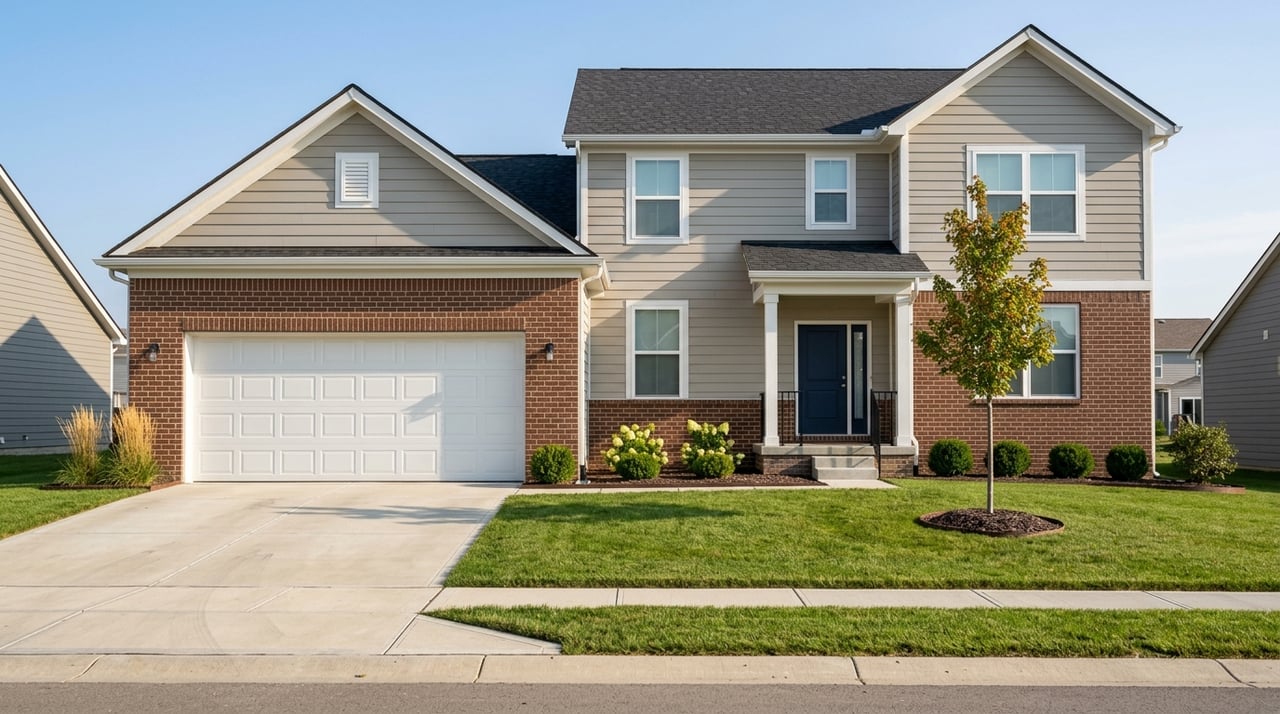
Trying to choose between a brand-new home and an older one in Franklin? You are not alone. In 46131, you can find everything from new subdivision homes in the high $200s and $300s to historic houses near downtown with deep character and very different upkeep needs. If you are weighing style, budget, maintenance, and long-term fit, this guide will help you compare your options with more confidence. Let’s dive in.
Franklin gives you both options
Franklin stands out because it offers a mix of tradition and newer growth. The city describes its housing identity as a blend of historic character and innovation, with Victorian mansions along King and Jefferson streets and a historic downtown core.
That variety gives you real choices. Recent 2026 market snapshots place 46131 in the low-to-mid $300,000s, with one tracker showing a median sale price of $318,000 in March 2026 and another showing a median listing price of $337,300 in June 2026, with homes spending about 33 days on market.
New-build prices in Franklin
New construction in Franklin covers a wide range. Some communities start in the high $200,000s or low $300,000s, while others move into the mid-$300,000s and $400,000s. Custom-home options can rise well above $500,000 depending on the lot and finishes.
That matters because “new construction” is not just one thing. In Franklin, you may be comparing an entry-level production home, a larger move-up home with more included features, or a custom build with separate lot costs and a much higher finish level.
What entry to midrange new builds look like
Some Franklin-area communities offer homes from the $260,000s to the $300,000s. Examples in the market include homes with ranch and two-story layouts, three to five bedrooms, and square footage that can range from about 1,300 to more than 3,000 square feet.
Depending on the builder and community, features may include seeded or sodded yards, landscaping packages, basements, open-concept layouts, stainless-steel appliances, quartz countertops, smart-home technology, and energy-saving features. What is included can vary a lot, so the base price is only part of the story.
What higher-end new builds offer
As you move up in price, you will usually see larger floor plans, more finish choices, and upgraded community amenities. In Franklin, some newer-home options currently reach into the $400,000s, while custom-home opportunities can climb far beyond that.
If you are considering a custom or semi-custom route, pay close attention to whether the advertised price includes the homesite. In some cases, the lot is priced separately, which can significantly change your total budget.
Older homes offer a different value
Older homes in Franklin are closely tied to the city’s historic core and established neighborhoods. The downtown area includes late Victorian Italianate and Beaux Arts structures dating from roughly 1880 to 1930, and Franklin highlights the Victorian homes along King and Jefferson streets as part of its local identity.
Outside the historic core, established neighborhoods can also offer larger lots, deeper setbacks, and a wider mix of home sizes and designs. Franklin planning documents describe suburban residential lots around a quarter acre as a standard point of reference, and local listings show that many older homes sit on lots that feel more established and varied than newer subdivision sites.
What older homes may include
An older home in Franklin might give you features that are hard to duplicate in a new build at the same price. That can include mature trees, brick construction, covered porches, distinctive architecture, or a lot that feels less cookie-cutter.
Local examples show just how broad the range can be. One 1900 home on West King Street was listed at $335,000 with 3,861 square feet and five bedrooms, while a 1965 brick ranch sat on 0.34 acres in an established setting. Even homes from the 1970s and early 2000s show how much lot size and layout can vary across Franklin.
Maintenance is often the biggest difference
For many buyers, the real debate is not just style. It is maintenance. This is where new builds and older homes usually separate the most.
Newer homes often have an advantage because the building envelope, insulation, roof, HVAC, plumbing, and electrical systems are all newer. The U.S. Department of Energy notes that many older homes have less insulation than homes built today, and adding insulation during new construction is usually more cost-effective than retrofitting it later.
Why new homes may feel easier at first
A new home can offer more predictable near-term costs. If the roof, furnace, air conditioner, and water heater are all new, you are usually less likely to face a major replacement right after closing.
That does not mean maintenance disappears. It simply means the first few years may come with fewer surprise capital expenses, especially compared with an older home that has aging systems.
Why older homes need closer review
An older home can still be a great fit, but you will want to look more closely at condition. Pay special attention to the age of the roof, HVAC system, water heater, windows, and insulation.
You should also ask about drainage, past repairs, and any updates or additions. In a place like Franklin, where older homes often come with mature landscaping and established settings, the property’s upkeep history matters just as much as the year it was built.
Warranties can change your risk
Warranty coverage is another major difference. The Federal Trade Commission says most newly built homes come with a builder warranty, often covering workmanship and materials for one year, major systems like HVAC, plumbing, and electrical for two years, and major structural defects for up to 10 years.
That can provide peace of mind, especially if you want more clarity about what happens after move-in. It is one reason some buyers feel more comfortable stretching their budget for a newer home.
Know the difference between warranties
A builder warranty is not the same thing as a home warranty. The FTC notes that a home warranty is typically a separate service contract, often used with existing homes, and it usually covers certain appliances or mechanical systems for an added fee.
If you are comparing a new build to an older home, ask exactly what protection is included and who handles claims. Clear answers here can help you compare two homes more fairly.
New builds require smart questions
If you are considering new construction in Franklin, ask detailed questions early. Builders can differ on included features, lot premiums, timelines, and upgrade pricing.
A model home can make the standard package look more generous than it really is. That is why you want to compare the actual base price, the included finishes, and the cost of the options you care about most.
Ask builders these questions
- What is included in the base price?
- Which finishes, appliances, flooring, and exterior features cost extra?
- Is the home move-in ready, under construction, or a buildable plan?
- Are basements available on this homesite?
- What warranty is included, and how are claims handled?
- How are permits and inspections handled locally?
In Franklin, the Planning and Engineering Department handles permits and building inspections, and inspections must be scheduled at least one business day in advance. That local process is worth understanding when you are trying to time a sale, move, or rate lock.
Older homes need a different checklist
When you tour an older home, your questions should focus more on condition, update history, and utility setup. A home with great charm can still come with future projects, and it is better to know that before you make an offer.
That does not mean you should avoid older homes. It just means you need a clearer picture of the home’s current systems and any likely repairs after closing.
Ask sellers these questions
- How old are the roof, HVAC system, water heater, and windows?
- Has insulation been added or updated?
- Were additions or remodels permitted and inspected?
- Does the property use public water and sewer, or well and septic?
- What repairs or maintenance have been completed in recent years?
- Are there any known drainage or moisture issues?
In 46131, utility setups can vary by location. Some properties use public water and sewer, while others may rely on private well and septic systems, especially outside more centralized areas.
Which home type fits your goals?
If you want modern finishes, warranty coverage, and a simpler path to lower near-term maintenance, a new build may fit you best. This can be especially appealing if you prefer a more predictable move-in experience and want fewer immediate repair concerns.
If you value character, established surroundings, mature trees, or a more distinctive lot, an older home may be the better match. In Franklin, that can mean anything from a historic home near downtown to a mid-century ranch in an established neighborhood.
The right answer depends on how you want to live, not just what looks best online. Your budget, your timeline, your comfort with maintenance, and your must-have features should all shape the choice.
If you are comparing new builds and older homes in Franklin, having a local guide can make the process much clearer. Angi Oakes can help you weigh builder options, compare resale value, and narrow down the best fit for your goals.
FAQs
What is the typical price range for new builds in Franklin 46131?
- New construction in Franklin currently ranges from the high $200,000s and low $300,000s in some communities to the $400,000s in others, with custom-home options reaching above $500,000 depending on lot and finish level.
What do older homes in Franklin usually offer buyers?
- Older homes in Franklin may offer historic architecture, mature trees, established neighborhoods, covered porches, brick construction, and in some cases larger or more distinctive lots.
Are new homes in Franklin easier to maintain than older homes?
- New homes often have newer insulation and major systems, which can reduce the chance of immediate replacement costs, while older homes usually need a closer review of roof age, HVAC age, insulation, drainage, and repair history.
What warranty comes with a newly built home in Franklin?
- Many newly built homes include a builder warranty, commonly covering workmanship and materials for one year, major systems for two years, and major structural defects for up to 10 years.
What should you ask before buying an older home in Franklin?
- You should ask about the age of the roof, HVAC, water heater, windows, insulation, utility setup, permitted updates, and any known repairs or maintenance issues.
How do you decide between a Franklin new build and an older home?
- A new build may be a better fit if you want modern finishes and lower near-term maintenance, while an older home may be a better fit if you want character, established surroundings, and a more unique lot or layout.